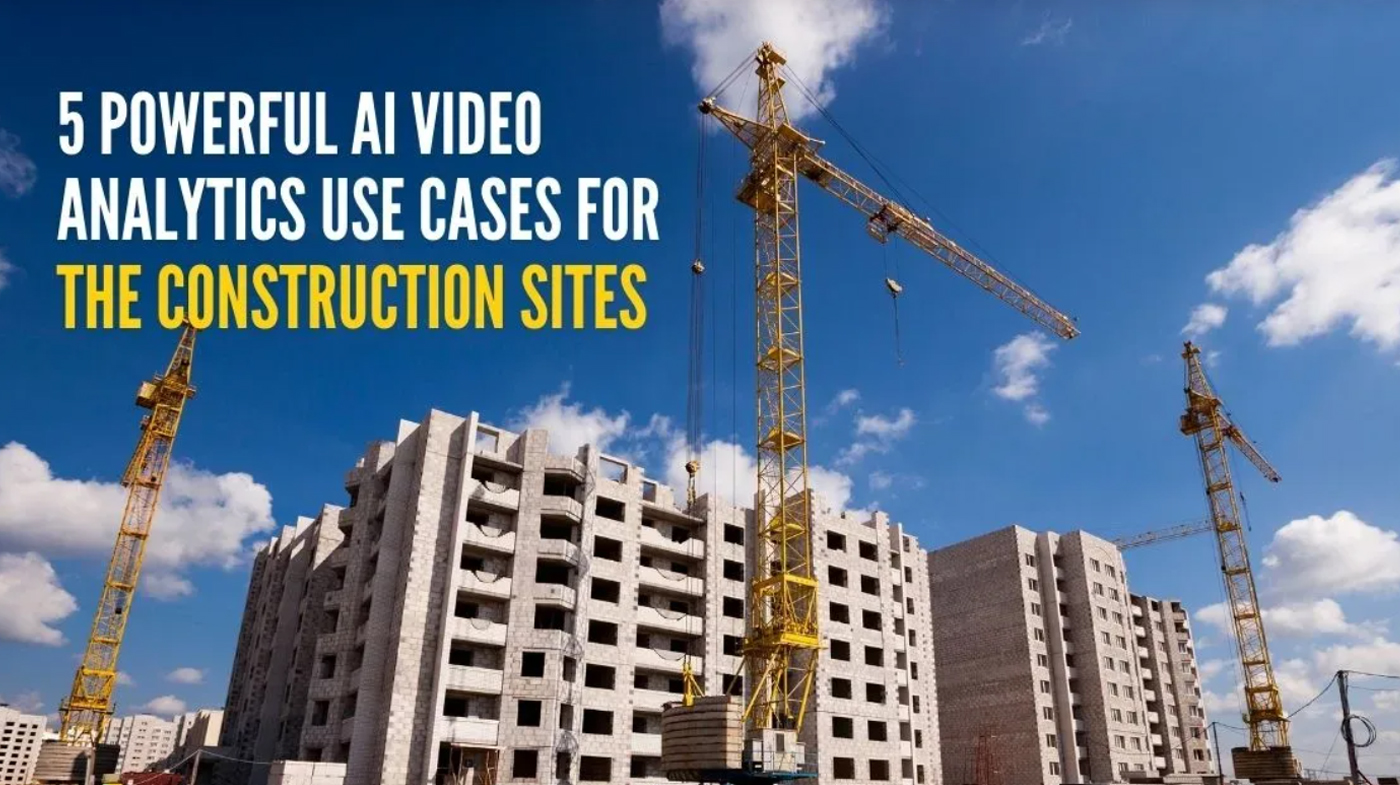





Construction sites represent highly dynamic and inherently dangerous working environments. Heavy machinery, multiple contractors, moving vehicles and constant activity create countless opportunities for incidents. Traditional supervision methods often struggle to keep up with this fast-paced, risky environment.
Today, companies are choosing to automate monitoring in construction sites using AI video analytics technology not just to prevent accidents, but to build a smarter, more proactive safety culture.
Let’s explore six impactful AI video analytics solutions that are redefining how safety and compliance are managed in the construction industry.
Construction sites operate in a constant state of movement. Trucks arrive with materials, goods are unloaded, and equipment is transported across different zones. Manually tracking these activities can be time-consuming, prone to human error, and difficult to manage at scale.
AI-powered video analytics transforms this process by automatically detecting loading and unloading activities in real time. At the same time, Automatic Number Plate Recognition (ANPR) technology captures and logs vehicle entry and exit data without manual intervention.
Together, these capabilities enable:
Accurate tracking of goods and materials
Automated vehicle entry and exit logging using ANPR
Improved coordination between suppliers and site managers
Reduced material discrepancies and disputes
Enhanced security and operational transparency
By turning standard CCTV cameras into intelligent monitoring tools, construction companies gain better visibility into material flow and vehicle movement—without adding additional manpower. The result is improved efficiency, stronger supply chain control, and more secure site operations.
Despite well-defined safety protocols, PPE non-compliance continues to be one of the most prevalent risks on construction sites.
AI video analytics-based PPE compliance algorithm detects whether workers are wearing helmets, safety vests, gloves, or harnesses in real time. By replacing manual inspections with automated monitoring, companies can achieve continuous and real-time safety compliance across the entire site.
The following are the major advantages of such systems:
AI solutions in construction ensure that safety rules are not just displayed but are actively enforced.
Falls remain one of the leading causes of injuries on construction sites worldwide. In high-risk areas such as scaffolding, rooftops, and elevated platforms, even a few minutes of delayed response can make a critical difference.
Advancements in artificial intelligence are changing how such incidents are managed. Using computer vision and deep learning, AI-powered video analytics systems can continuously monitor worksites and detect fall events instantly.
When a fall is identified, supervisors receive real-time alerts, enabling faster response and immediate action.
By reducing response time and enabling proactive monitoring, this technology helps ensure that injured workers receive immediate attention when they need it most. In high-risk and elevated work zones, a timely response can make a meaningful difference in protecting lives and supporting the well-being of every worker on site.

Managing workforce access and attendance across large construction sites can be challenging, especially when multiple teams and contractors operate simultaneously.
Facial recognition technology simplifies this process by enabling:
This is particularly valuable in restricted or high-risk areas where only certified personnel are permitted to work. By integrating facial recognition into the site’s monitoring system, the platform helps ensure that only the right individuals are present in sensitive zones, supporting both safety and operational efficiency.
Heavy machinery is essential on construction sites, but it can become dangerous when workers enter restricted operating zones. In busy environments, even a brief lapse can lead to serious accidents.
Our AI-powered video analytics system continuously monitors predefined danger zones around equipment. If a worker steps into an unsafe area, the system instantly detects it, sends real-time alerts to operators and can trigger an IoT-enabled signal to slow down or stop the machine. An on-site alarm can also be activated to warn nearby personnel.
This enables:
Instead of reacting after an incident, construction teams can prevent accidents before they happen, helping protect workers when it matters most.
Construction sites are dynamic, challenging environments, different lighting conditions, changing weather, multiple camera angles and constant movement. Our AI video analytics software is trained on real-world site footage across various industries and outdoor conditions, ensuring reliable performance where it matters most.
Our AI video analytics software works seamlessly with your existing CCTV infrastructure, delivering over 95% accuracy to generate precise insights and actionable reports. As safety regulations evolve, our AI models can be quickly retrained to detect new types of violations, without requiring additional hardware investments.
When you partner with us, you’re not just adopting technology. You’re choosing a team that supports you with ongoing customization, continuous improvements, and a solution tailored to your site’s unique challenges.
Workplace safety technology is advancing rapidly. From real-time PPE compliance monitoring to instant fall detection and danger zone alerts, AI video analytics is reshaping how construction sites manage risk.
When safety becomes proactive instead of reactive, incidents decrease, productivity improves, and teams operate with greater confidence and peace of mind.
In high-risk environments like these, intelligent monitoring isn’t just an upgrade, it’s becoming the standard for safer, smarter operations. And we’re here to help you make that transition smoothly.
Vectra AI, recently released its 2026 State of Threat Detection and Response...
ByDTC NewsFebruary 19, 2026While most hospitals and health systems are investing in AI solutions, nearly...
ByDTC NewsFebruary 19, 2026Many Bids lose not because the capability is lacking, but because the...
BydtcFebruary 18, 2026Ivanti recently announced the findings of its 2026 State of Cybersecurity Report:...
ByDTC NewsFebruary 18, 2026